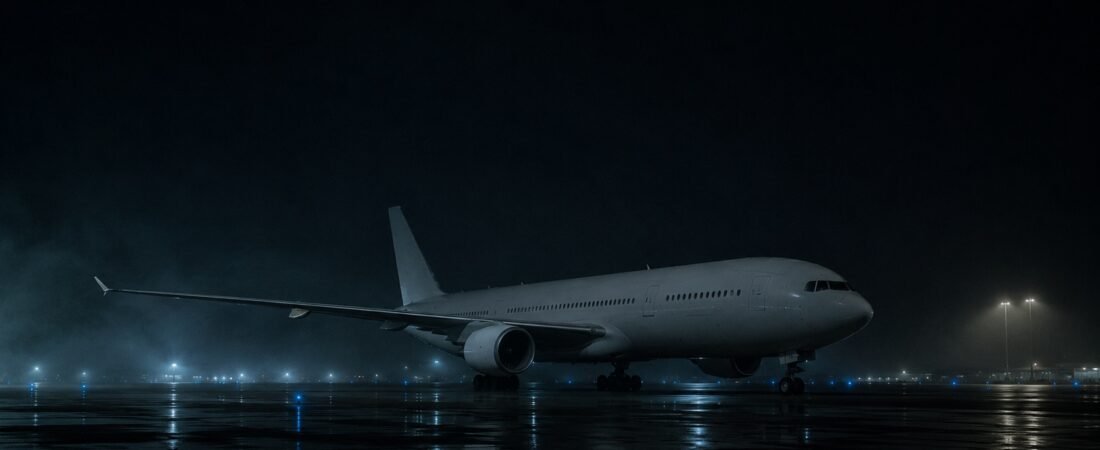
Netflix dropped a French action thriller called Elite Force on July 22, 2026, and it went to number one worldwide inside a few days. The show dramatizes France’s GIGN, the counter-terror unit of the National Gendarmerie. It was made with the cooperation of the actual unit, and critics keep praising its tactical authenticity.
The tactical realism is the easy part to notice. The harder part, the part most viewers miss, is that the unit’s real signature operation was won and lost in the intelligence phase, long before anyone stacked on a door. That operation was the hijacking of Air France Flight 8969 in December 1994. It is still taught in aviation security courses as one of the defining hostage-rescue case studies of the pre-9/11 era. It deserves a closer look through an intelligence lens, because the assault everyone remembers was the output of an intelligence process, not the story itself.
What Actually Happened on Flight 8969
On December 24, 1994, four members of the Armed Islamic Group boarded an Air France Airbus A300 at Houari Boumediene Airport in Algiers. They were dressed as Algerian police, and they moved through the cabin checking passports before they revealed their weapons. Algeria was in the middle of a brutal civil war at the time. The route was so dangerous that Air France crewed it only with volunteers.
The hijackers killed three passengers over the next two days, including an Algerian police officer and a Vietnamese diplomat, partly to prove intent and partly to pressure the standoff. The aircraft sat on the tarmac in Algiers for roughly two days while Algerian authorities refused to let it take off. Eventually, under French pressure, it flew to Marseille. There, in the early hours of December 26, GIGN operators stormed the aircraft, killed all four hijackers, and got every remaining passenger and crew member off alive.
That is the skeleton. The intelligence story lives inside it.
Did Intelligence See This Coming?
Partly, and faster than most people assume. French intelligence was already monitoring Algerian military and police radio traffic as a matter of routine, given the civil war next door. When something went wrong at the Algiers airport, that collection posture meant Paris knew a hijacking was underway within about 15 minutes. The elite counter-terror unit was put on standby almost immediately.
This is the first lesson worth pulling out. Warning did not come from a single dramatic tip. It came from a standing collection capability aimed at the right target for unrelated reasons. The radio monitoring existed to track the Algerian conflict. It happened to catch the opening moments of a terror operation. Good intelligence posture often works like that. You build the sensor for one reason and it pays off in a way you did not plan.
So the initial detection was a success. The threat assessment that followed is where the story gets genuinely interesting.
How the French Read the Hijackers’ True Intent
Early hijackings followed a script. Seize the aircraft, use the passengers as leverage, make demands, negotiate an exit. The hostages were bargaining chips, not intended casualties. For decades that script held, and it shaped how governments responded.
Flight 8969 broke the script, and the French had to figure that out in real time.
The clearest analytical tell was fuel. Late in the standoff, the hijackers demanded close to 27 tons of fuel. The flight to Paris needed about 9. That gap is the kind of hard data point that changes an assessment. A crew planning a normal flight asks for what the flight requires. A crew planning to turn the aircraft into a weapon asks for as much as it can carry. Analysts read the excess fuel request as evidence that the plane itself was meant to be the bomb, either flown into a target or detonated over the city.
The suspected target was the Eiffel Tower, with the Tour Montparnasse as an alternate. The assessment was not a guess pulled from the air. It came from the behavioral evidence, the group’s profile, human sources, and the fuel demand read together.
Here is the part that removes any doubt about whether this was hindsight mythmaking. The sitting French Prime Minister at the time, Edouard Balladur, later stated on the record that intelligence had determined the operation was a suicide mission aimed at Paris and the Eiffel Tower, and that this determination was exactly why he took the measures to force the aircraft down at Marseille rather than let it continue. The threat read drove the single most important decision of the entire crisis, which was where the plane was allowed to land.
That is intelligence doing its actual job. Not predicting the future, but converting ambiguous behavior into a defensible assessment fast enough to act on it.
Negotiation as a Collection Operation
Most people think of hostage negotiation as stalling for time so the assault team can get into position. That is part of it. It is not the whole function.
The two-day standoff, first in Algiers and then during the hours at Marseille, was also an active intelligence collection operation. Every radio exchange, every demand, every observed movement inside the cabin fed the picture. Negotiators learned the number of hijackers, their positions, their weapons, their mood, and their level of exhaustion. By the time the aircraft reached Marseille, the operators had a far better model of the inside of that plane than they would have had from surveillance alone.
The assault plan depended on that model. GIGN intended to isolate the cockpit from the rest of the cabin, which is a plan you can only build if you know where people are and how the aircraft is laid out under stress. Negotiation was the sensor. The tactical decision was downstream of what it collected.
For an intelligence audience this is the reframe worth keeping. Talking to the adversary is not the opposite of acting against them. Done well, it is the collection phase that makes the action survivable.
Where the Intelligence Story Turns Into a Warning
Call this the failure inside the success, because it is the honest verdict and it matters more than the clean win.
Flight 8969 was, in retrospect, a preview of a threat model the world did not take seriously until September 11, 2001. A civilian airliner deliberately turned into a guided weapon against a national landmark. In 1994 the French confronted that exact concept, assessed it correctly, and stopped it. The intelligence and the operators both performed.
Then the lesson did not travel. The idea that a passenger jet could be used as a missile against a city was demonstrated, understood at the highest levels of a Western government, and documented in security case studies. Seven years later that same concept succeeded on a larger scale, against a country that had not internalized what the French already knew.
This is the uncomfortable pattern that recurs across intelligence history. The failure is often not detection. It is diffusion. One service learns a hard lesson at real cost, and that lesson fails to propagate to the people who will need it next. Flight 8969 was not an intelligence failure in the moment. It was arguably a failure of institutional memory across borders and across years.
The tactical authenticity in Elite Force is what draws viewers in. The deeper story, the one worth studying, is that the unit’s most famous save was fundamentally an intelligence achievement, and that the intelligence achievement came with a warning nobody acted on in time.
The Analyst’s Takeaway
Strip the gunfire out of Flight 8969 and you are left with a clean sequence that any intelligence professional will recognize.
A standing collection capability caught the event early. Analysts read ambiguous behavior, anchored to a hard data point, and produced a threat assessment that broke with decades of assumptions. That assessment drove the decisive policy choice. A negotiation phase doubled as collection and sharpened the operational picture. The assault succeeded because the intelligence work in front of it succeeded.
And then the most important product of the whole affair, the demonstrated proof that aircraft could be weapons, sat unlearned by the people who needed it most.
The operators get the film. The analysts got there first. The lesson, tragically, arrived everywhere else too late.